A project with a purpose
Maine Big Night (MBN) is a nonprofit community science project established to confront the issue of amphibians becoming roadkill en masse. Amphibians, already facing stronger threats than many other groups of wildlife, can see localized declines due to roadkill, and are especially vulnerable during their punctual annual migrations. MBN organizes volunteers to assist these animals across the road while collecting valuable data to protect them for decades to come.
MBN is a community science project – a project that is run by community members of all backgrounds to research and protect these amphibians.
The Maine Big Night Story
It all starts at the dawn of time. Amphibians, acting as the connection between land and water, are sensitive animals that need conditions to be just right to feel comfortable in any one spot. When temperatures were warm enough and the ground wet enough, they would be free to move until temperatures drop or things got dry. Additionally, many of them still required water to lay their eggs and raise their young in; they are, after all, not much more than fish with legs.
Read More
For many of these amphibians, the solution was a simple one – spend most of their lives in the forests, meadows, and wetlands, eating insects and hiding underground or in the shadows, waiting for the right moments to move. After a long winter of hiding beneath leaves, soil, and logs, many will emerge when things are just right – when temperatures reach approximately 40 degrees Fahrenheit and the ground is soaked in rain. Oh, and it has to be night.
With such picky creatures, it makes sense why so many move at the same time – their options are limited. In migrations that parallel the wildebeest of the Serengeti and the caribou of the tundra, salamanders and frogs pour out from their forest slumber lands to wetlands to breed.
For eons, this massive migration – a big night, sure enough – was impaired only by hungry owls, newly fallen trees, and perhaps the occasional flood that sent some amphibians astray. But, in the past few centuries, a new, often un-survivable barrier has emerged – roads.
Jump to 2003, and project founder and Executive Director, Greg LeClair (then seven years old), was returning home with his family on a warm, rainy night in April. Upon walking to his doorway, he was met with a female Spotted Salamander – the first he had ever seen. This large, jet-black being with bright yellow spots excited him deeply, and here it was – in his driveway.
That incident started a series of looking outward when it rained, and Greg quickly expanded his searches from his driveway to his neighborhood road. Certainly, it did not take long to realize the major issue at hand – frogs and salamanders were being struck by vehicles constantly, and drivers were entirely unaware at the ecological mayhem occurring between them and the pavement.
With years of saving amphibians from road under his belt, Greg started a big night project in 2018 during his senior year of college. The project, intended just to cover the local town, was a success – just under fifty amphibians were recorded for the project, and multiple news outlets covered the event.
However, with graduation looming and wanting to continue the project, Greg decided to take the project to the next level – it would become the first statewide big night project, covering sites from York to Aroostook county. This was Maine Big Night.
Now, the project has grown immensely since those days; with over twenty thousand amphibians now recorded in the project, multiple awards, scientific publications, major media coverage, and even inspiration for books, Maine Big Night has become a leading example of community conservation.
The brave, salamander-savin’ Mainers
Mainers are known for being rugged, and in this project, that notion shines through. Every spring, our project volunteers endure rain, cold, and late nights to ensure as many frogs and salamanders cross roads as possible. At the same time, they are collecting data that can be used to improve our understanding of how wildlife interacts with our infrastructure and how to protect wildlife, including amphibians, with smarter infrastructure design. Our volunteers are of many backgrounds; from toddler to senior, foreign exchange student to local celebrity, business owner to scientist, we accept and train anyone who can be safe in the road. We even work with people with physical and mental disabilities to ensure their participation is possible.
Maine Big Night is a 501(c)3 nonprofit organization. Our EIN is 93-4855076 and we can receive tax-deductible contributions through a variety of means. If you would like to support our project, please see our Support page.
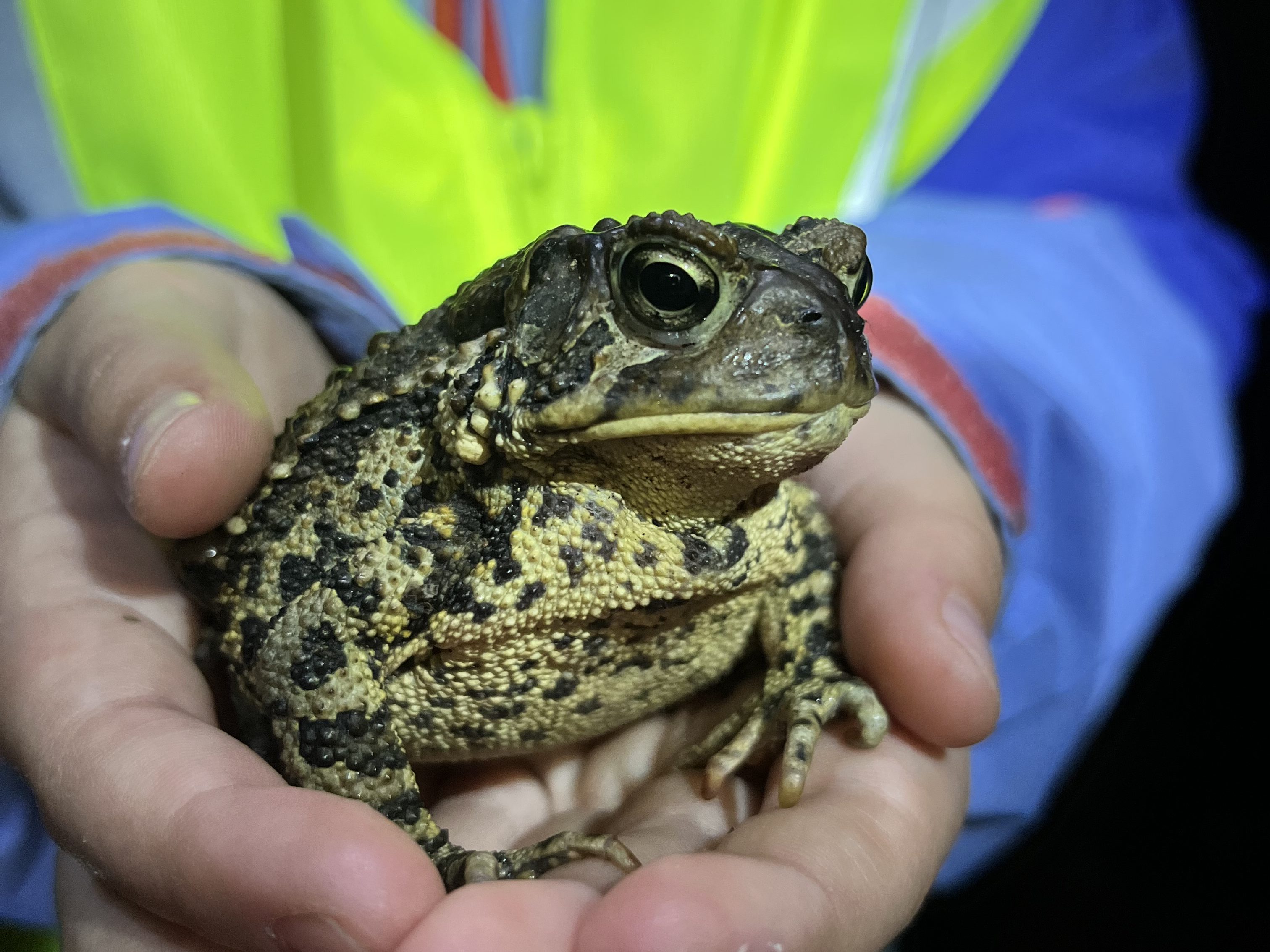
American Toad photo by Emily Kenniston.
 Maine Big Night: Amphibian Migration Monitoring