Spread the Word About Maine Big Night!
One of the best ways to amplify our mission and increase our impact is by sharing the story of Maine Big Night in your local community. Use our toolkit to craft a compelling article and submit it to your local newspaper as a Letter to the Editor or an Op-Ed.
Guidelines for Writing
- Know the Limits: Newspapers often have word count and content restrictions. Letters to the editor are typically around 150 words, while op-eds are longer, ranging from 600-1,200 words.
- Stay Positive: While it’s essential to highlight the issues we’re addressing, focus on solutions and the positive impact Maine Big Night is making.
- Make It Local: Tailor your article to resonate with your community. Highlight how amphibian migration events affect your area or share personal experiences.
Requirements for Submission
To ensure your article effectively represents Maine Big Night, please include the following:
- Website Link: If encouraging readers to participate, direct them to www.mainebignight.org for more information.
- Call to Action: Inspire readers to get involved by volunteering, donating, or spreading the word.
- Accuracy: Include factual details about Maine Big Night’s mission, impact, and how your community can benefit.
Want to ensure your article is polished and impactful? Send us your draft at mbn@mainebignight.org for feedback before submission.
Quick Writing Tips
- Keep your sentences short and clear.
- Use a conversational tone to connect with readers.
- Incorporate personal anecdotes, if applicable, to make the article relatable.
Talking Points
Any of the below may be used in writing your article. If you want more information, please feel free to reference our annual reports.
1. The Benefits of Amphibians
- Ecological Importance: Amphibians are an important food source for many of our wildlife species, and also act as a control on many other species like mosquitos. They also play large roles in nutrient cycling, including fertilizing Maine’s forests and storing carbon.
- Indicators of Ecosystem Health: Amphibians are highly sensitive to environmental changes, making them critical indicators of ecosystem health.
2. The Benefits of Connectivity
Connectivity is the idea of patches of habitat being connected. Connectivity is important for wildlife since they oftentimes need to move between habitats, but is frequently threatened by things like roads.
- Wildlife Health: Connected habitats reduce the risks of inbreeding and population isolation, supporting healthier wildlife populations.
- Ecosystem Function: Continuous habitats allow animals to perform their ecological roles more effectively by being able to reach the resources they need.
- Adaptability: When wildlife habitats are connected, they are able to respond to change by shifting to new locations to meet their needs. This, coupled with the ability to reach other groups of the same species, makes them more resilient.
3. How Improving Wildlife Connectivity Benefits People
Placing a road crossing structure, having volunteers present to assist amphibians across roads, or improving access through a culvert can have many benefits to both wildlife and people, including:
- Safer Roads: Reducing wildlife-vehicle collisions not only saves animals but also reduces accidents for drivers. We spend $8 billion per year as a country because of wildlife-vehicle collisions, with Maine spending $314 million/year between 2018 and 2022.
- Resilient Infrastructure: Roads that provide passage for wildlife are much more resistant to damage from major weather events such as flooding.
- Improved Ecosystem Services: A naturally functioning environment provides tremendous benefits to people, including anything from improved fishing opportunities to cleaner water and nutrient cycling.
4. Successes of Maine Big Night
- Lives Saved: Thousands of amphibians saved annually through volunteer efforts, including over 9,000 in 2024 alone.
- Data Collected: Critical information on amphibian migration routes and population trends, including data on over 35,000 amphibians since the start of the project and identification of high-impact sites like Forest Avenue in Orono and Boyd’s Corner Rd in South Berwick.
- Growing Network: Hundreds of people across Maine engaging in hands-on conservation every year, including assisting amphibians in roads, collecting data, attending presentations, and more.
Example Pieces
Letter to the Editor (150 words)
Amphibians are some of the most fascinating and important creatures in our ecosystems, yet they face significant threats from habitat fragmentation and road mortality during migration. Maine Big Night is stepping in to make a difference by helping volunteers assist amphibians during their annual spring migrations to breeding pools.
This community science initiative not only saves thousands of amphibians each year but also collects vital data to inform wildlife conservation and improve road planning for better wildlife connectivity.
Join us in protecting Maine’s amphibians and the ecosystems they support. To learn how you can volunteer or contribute, visit www.mainebignight.org. Together, we can create safer habitats for wildlife and strengthen our connection to nature.
[Your Name]
[Your City]
Op-Ed (600-800 words)
Safe Roads for People and Wildlife
Among the threats to wildlife, few impact as many subjects as a roadway. Paved roadways and automobiles have existed in Maine for just over 100 years, and highways only 60 years. However, in this short period of time, these new paved landscape features have had major impacts to wildlife, their habitats, and people.
When a road is put in place, it brings multiple changes with it. The open pavement brings sunlight to areas that may have been darkened by a dense canopy, creating a sunnier, warmer, and drier space than before. New plants and certainly many invasive species will follow roadways like rivers through a landscape. Pollution of many sorts may also be dispersed from roads; road salt, heavy metals, and even the noise produced from tires can disrupt the quality of habitats and behaviors of wildlife.
However, perhaps the most damaging aspect of roads is related to habitat connectivity. Habitat connectivity refers to the ability of animals to move between patches of habitat – if patches are close and relatively unblocked, connectivity is high and populations are able to reach the food, shelter, and mates that they need in order to persist. If connectivity is low, populations may be subject to reduced resource availability, higher inbreeding, and ultimately lower populations. As patches become more isolated, the “island effect” takes place as individuals are essentially surrounded by uncrossable oceans – think a patch of forest in the middle of a city.
While many may not think of roads as particularly difficult to cross, it is important to consider the different behaviors, perceptions, and challenges wildlife may experience in crossing roads. Highways are easily understood as being difficult to cross – passing four or more lanes of high-speed traffic is daunting for the species that built them. Certainly, these form “moving fences” where high levels of traffic may ultimately dismay traveling wildlife from attempting to cross.
On quieter roads, more interesting effects take place. Deer and other larger species may bound across quickly and easily, though as many a Mainer knows, drivers must maintain caution driving through rural landscapes. Predators, such as bear, coyote, and others, tend be quite timid and may avoid crossing roads that host even just a few cars per day. Others will attempt to cross but will unfortunately employ a strategy that has worked well against predators, but not two-ton vehicles – freezing in the middle of the road. Turtles and squirrels are two examples that many of us have encountered. Then, there are those that simply don’t respond to traffic and become roadkill en masse.
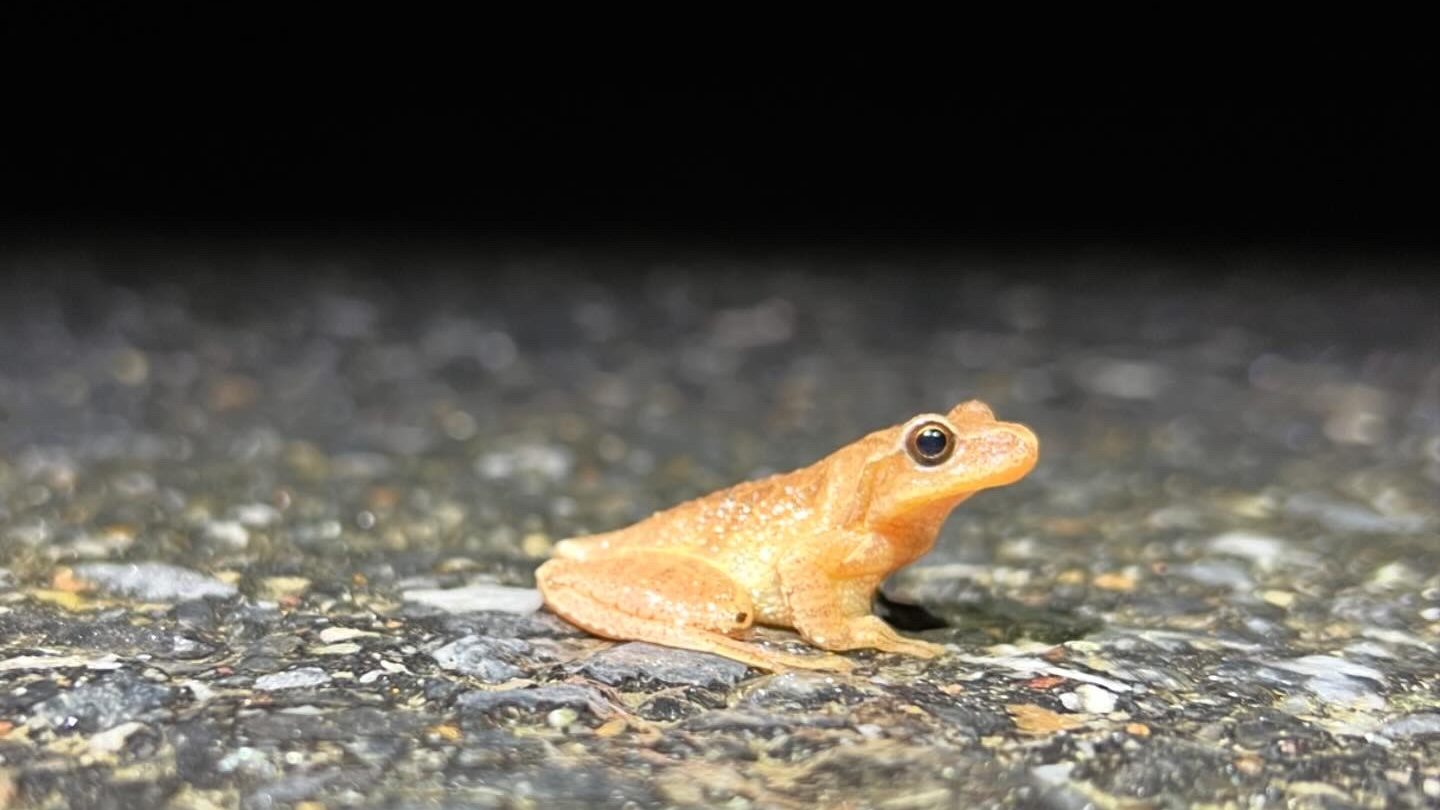
Each spring, something extraordinary happens across Maine during the first rainy nights: thousands of amphibians—frogs and salamanders—embark their annual migration to breeding locations. These migrations traverse our cities, towns, and backyards – the scale is beyond that of the wildebeest migrations in the Serengeti, and it happens right under our noses. Unfortunately, many of these journeys involve some of these individuals (some of them decades old) crossing roads to reach their destinations. Unable to see these animals and unaware that these nights are full of migrating amphibians, motorists throughout Maine and the eastern United States are inadvertently causing some of the highest road mortality rates of our wildlife by driving on warm, rainy spring nights.
Maine Big Night (MBN), a nonprofit community science initiative, brings together volunteers to aid these creatures during their migration. In this program, anybody can become trained and sign up to survey a site near them to help amphibians cross safely while collecting valuable data to inform wildlife conservation efforts. MBN is a statewide project with nearly 600 sites available for participants to join, and the event is becoming an increasingly social and meaningful activity as impact grows and more participants join.
Ultimately, the goal of MBN and other similar work is to improve wildlife habitat connectivity in a way that is more permanent. Wildlife road crossing structures are of increasing interest, and more are installed in the US every year. These structures can be designed for a variety of wildlife, and by using data from MBN and other organizations such as the Maine Department of Transportation, towns and other planning groups can determine wildlife crossing hotspots deserving of a crossing structure. When put in the right place, a crossing structure can save immense amounts of taxpayer money and greatly improve public safety; Mainer’s spend over $300 million per year on wildlife-vehicle collisions on top of ecological impacts.
MBN is a project open to all. To learn how to get involved and make a difference in your community, visit www.mainebignight.org.
 Maine Big Night: Amphibian Migration Monitoring